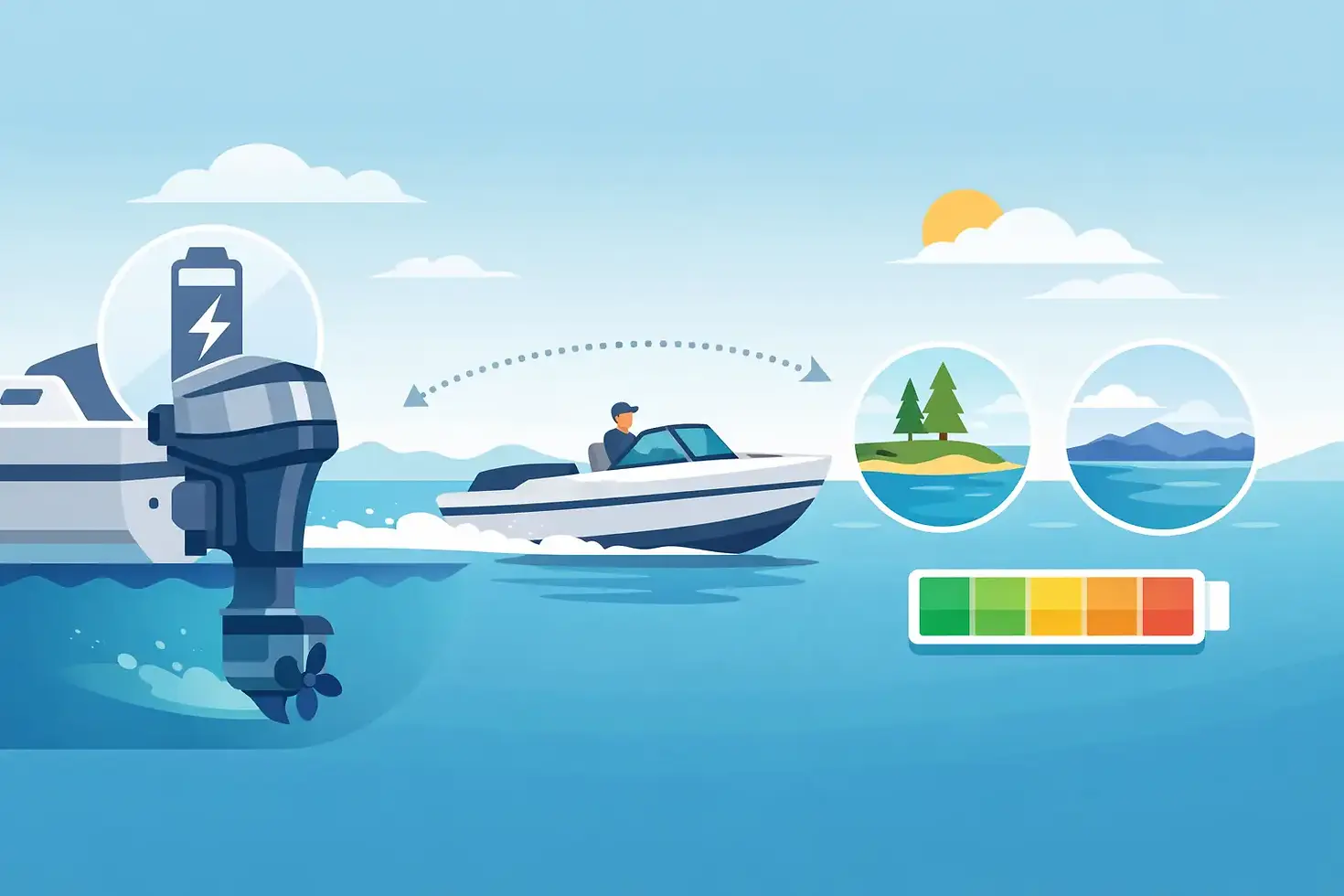
Electric Outboard Range Per Charge Explained
Ask two boat owners how far an electric outboard will go on one charge, and you’ll usually get two wrong answers. One is wildly optimistic. The other assumes electric power is only good for creeping around a cove. The truth is more useful than either extreme. Electric outboard range per charge is real, predictable, and highly dependent on how you run the boat.
That last part matters. If you expect full-throttle performance all day, range will disappoint you no matter what badge is on the cowling. If you understand how speed, hull efficiency, battery capacity, and load work together, electric range stops being a mystery and starts becoming a real planning tool.
What electric outboard range per charge really means
Range per charge is not a fixed number baked into the motor. It is the distance your boat can travel before the battery reaches its usable limit. That means range is a product of two things working together - how much energy you have onboard, and how quickly your boat uses it.
Think of it the same way serious boaters think about fuel burn. A gas outboard does not get the same mileage at idle, on plane, and at wide-open throttle. Electric is no different. The difference is that electric systems make the relationship more obvious. Power draw rises fast with speed, especially once you start pushing a hull harder through the water.
So when someone asks, “What’s the range?” the honest answer is, “At what speed, on what boat, with how much battery, carrying what load?” That is not a dodge. That is how real range works.
The biggest factors that change range
Battery capacity is the first one. More stored energy means more runtime, plain and simple. But battery size alone does not tell the whole story, because a heavy, draggy hull can burn through that energy far faster than a lighter, more efficient setup.
Hull type has a huge effect. A narrow, efficient skiff moving at moderate speed will usually stretch charge farther than a heavier bay boat or a hull loaded down with gear, passengers, and a full cooler. Boats that can get on plane efficiently can also improve practical range in certain conditions, because they spend less time plowing through the water in that inefficient transition zone.
Throttle setting is the range killer most owners underestimate. The jump in energy use from moderate cruise to high-speed running is not linear. It climbs fast. That means the last few mph often cost you far more battery than most people expect. If you run hard everywhere, you trade distance for speed. There is no way around that.
Conditions matter too. Current, wind, chop, and even water temperature can shift your real-world numbers. Running into a stiff headwind with a loaded boat is a different mission than cruising calm inland water with two people onboard.
Why speed matters more than most buyers think
This is where electric boating separates casual opinions from real-world performance. Many people focus on top speed. Serious owners should focus on the speed that gives the best usable range.
At very low speeds, electric outboards can be extremely efficient. That is why slow cruising, no-wake operation, and fishing applications can deliver impressive runtime. But most performance-minded boaters are not buying a serious outboard just to idle all day. They want acceleration, authority, and the ability to move a real boat with purpose.
At the other end of the spectrum, running near full throttle drains batteries quickly. That does not mean high-power electric outboards are impractical. It means they should be evaluated honestly. If your boating style involves short runs, quick hops between spots, waterfront cruising, or a mix of fast bursts and moderate-speed operation, electric can fit extremely well. If your normal day is a long, high-speed run with no breaks, range planning becomes much more important.
The sweet spot is usually a moderate cruise where the boat is operating efficiently without demanding maximum power. That is where electric outboard range per charge becomes most useful in the real world.
How to estimate your own electric outboard range per charge
Ignore generic claims until you match them to your boat. Start with battery capacity and expected power draw at the speeds you actually use. If your system stores a certain amount of usable energy and your boat consumes a known amount per hour at cruise, you can estimate runtime. Multiply runtime by cruise speed, and now you have a realistic range estimate.
This is the same mindset experienced boaters already use with fuel burn. The only difference is that electric numbers are often cleaner and easier to track once you know your setup. Over time, owners learn their boat’s efficient cruise, just like they know where a gas outboard settles into its best fuel economy.
You also need to leave margin. Nobody wants to come back to the ramp calculating the last percentage point. A smart range estimate includes reserve for current changes, detours, weather, and the simple fact that boat days rarely go exactly to plan.
If you are comparing systems, ask for real operating data tied to a specific hull, payload, and speed. Broad claims without context are marketing. Useful range data looks like a performance chart.
Planing changes the conversation
For years, one of the biggest knocks on electric marine propulsion was simple: it was fine for low-speed use, but not serious boating. That is exactly why planing capability matters.
A powerful electric outboard that can plane a boat is not just about bragging rights. It changes how the boat can be used. It means quicker runs, better control in changing conditions, and a wider range of practical applications for anglers, recreational users, and boaters who want more than trolling-motor performance.
But planing does not erase the laws of physics. Getting on plane and running fast takes energy. The value is not that battery consumption disappears. The value is that electric propulsion becomes viable for boaters who need actual outboard performance. That is a major difference.
This is where a performance-first brand like Stealth Electric Outboards stands apart. The goal is not to sell the fantasy of endless range. The goal is to deliver real electric power for real boats, including applications where getting on plane is non-negotiable.
What buyers should ask before trusting any range claim
Start with the boat. What hull was tested, how much did it weigh, and what was onboard? Then ask about the speed used for the range claim. A boat that can travel a long distance at low speed may deliver a very different number at planing cruise.
Next, ask about usable battery capacity, not just total installed capacity. Ask whether the claim assumes ideal conditions. Ask what reserve is left at the end of the run. These details separate honest range estimates from numbers designed to look good on a spec sheet.
You should also think hard about your own use case. Anglers making shorter runs and holding position near a fishery have different needs than coastal boaters covering long distances. A shallow-water owner who values quiet operation and low maintenance may accept a different range profile than a boater replacing a gas setup used for all-day high-speed runs.
That does not make one use case better than another. It just means fit matters more than hype.
The trade-off that actually matters
Every propulsion system has a trade-off. With gas, you accept noise, maintenance, fuel handling, and mechanical complexity in exchange for quick refueling and long range. With electric, you get quieter operation, instant torque, lower routine maintenance, and a different ownership experience - but your range is tied directly to your battery system and how aggressively you run it.
For a growing number of boat owners, that is not a compromise. It is a better match for how they really use their boat. Especially when the outboard has enough power to move beyond niche use and into true recreational performance.
The smartest way to think about electric outboard range per charge is not to ask for one magic number. Ask what range looks like on your boat, at your speed, on your water. That is where electric stops sounding experimental and starts sounding like the next obvious move.
If you want the benefits of electric without giving up real propulsion, range is not the question to avoid. It is the question to get specific about before you ever leave the dock.


Comments